Showing posts with label research. Show all posts

Saturday, May 14, 2011

Links I Like

Hello hello! Just popping in to add some info regarding Regency menswear that I've come across the last few months. Some of these links cover extant garments, some are historical reproductions. They're all useful to look at if you're thinking of making a gentlemen's outfit. I've organized the links by garment type, so there are a few repeats if a post covers multiple topics.

**If anyone would like me to remove the link to your site, please contact me and I will be glad to do so.

Here are the awesome blogs these resources are from, in no particular order. These blogs contain a lot more info than I've linked to here, so go poke around on them!
Jane Austen Today
Two Nerdy History Girls
Romantic History
A Tailor Made It
Drunk Tailor
Mackin-Art
Mme. du Jards Atelier
A Fashionable Stitch
Wearing History


Tailcoats

Shirts
18th C. Men's Shirt - including an explanation of why they were so long!

Waistcoats

Breeches & Trousers
Waistcoat and Trousers (repeat from above)

Accessories

Buttons & Buttonholes
Buckles and Buttons (repeat from above)

Tuesday, January 25, 2011

Jane Austen Evening 2011 - Menswear Recap

The men pulled out all the stops this year at the annual Jane Austen Evening! The ladies looked lovely, as always, but I thought the men really stepped it up. I've got a few pictures to share of the dapper men - but I missed quite a few, there were too many good-looking gents!

And first, what you've all been waiting for...drumroll please...

Chris in his suit! Here he's got on his tailcoat, waistcoat, shirt and cravat. You can see the little ventilation hole in the shirt that he insisted on leaving open lest he die from the heat. The 1930's pants were a big hit - lots of men were wearing modern pants, and he even got a few compliments on them.

 The annual meeting of the Tolerant Husbands Society. This Society is also open to any male friends or brothers that one might be able to bribe with cookies.

Look at the fabulous fit on this outfit! You have to be confident to wear it, that's for sure, and he was quite snazzy. I like the shirring at the sleeve cap. 

I snuck a back view - since he was gracious enough to pose for the front, I figured it was okay. :o) 

Another Chris! This gentleman sews his own clothes (maybe sometime I can get mixed up and bring him home instead of mine? Nah, we'd just fight over the ironing board or something). He's the mastermind behind this Royal Naval uniform that I've drooled over many times - I was so excited when I saw him walk by and had to go over to introduce myself!

I got a closeup of his neckcloth, very impressive! Chris said he used rice starch on his cravat, and Lauren realized that he used the Perfect Pleater for his shirt ruffles. I found his post on the rice starch on the Regency Society of America message boards, where he is a frequent poster, and I'm sure would be willing to answer any questions you might post. I'll probably pop over with a few of my own!

 Undoubtedly the cutest young gentleman at the Ball. Look at those stockings!

These next two outfits might be my favorites of the night, for sheer ingenuity. These men were accompanied by lovely ladies who deconstructed and repurposed thrifted suits, and turned them into incredible regency wear. What a great idea! you get all the fun of making cool collars etc, without having to make the icky welt pockets! (And they were quite well-done too - it wasn't until I was told *the secret* that I saw how they were remade!)

Another repurposed Regency suit, and the fine lady who made it. 

Showing where she pieced the tailcoat together - cut a little off the front, add it to the back, and voila!

And here ends my menswear recap...don't worry, I know I still owe you a review of the waistcoat I made, and probably a couple other things... :) If you want to see the tasty cookies from the event, pop over to V is for Vintage and say hi!

Sunday, January 9, 2011

18th C. Menswear Patterns from LACMA

Reposting this link from the fabulous Two Nerdy History Girls Blog. LACMA has posted free annotated pdf files online of patterns from their new costume collection - similar to the patterns from Tidens Toej, but these have notes in ENGLISH!!

1790's Tailcoat pattern for FREE!

Included are patterns for a men's tailcoat, 2 waistcoats, and a banyan (just learned that term - thanks Lauren!). I'm trying really hard to be happy that they chose all menswear for this project... ;)

Wednesday, November 24, 2010

Fashioning Fashion At LACMA

Men's Timeline
Women's Timeline
Last weekend a friend and I went to see the exhibit Fashioning Fashion: European Dress in Detail, 1700-1915 at the Los Angeles County Museum of Art. They acquired an extensive private collection a few years ago, and this is the first time these pieces have been on display. We took a gallery tour of the exhibit, and the docent promised that more exhibits are being planned for the collection. I hope so!


Here's a few shots of the exhibit - I was surprised at how it was designed to look so temporary, with every piece in its own "packing crate", but I enjoyed that most items weren't behind glass. The lighting was low and photography was only allowed without a flash, so most of the pictures are a little wonky. But that's typical for my blog! ;)
We were surprised
to see several garments
that didn't match
plaids or stripes!


If you can't make it to the exhibit, check out the gallery catalog - it's got wonderful detail images, and even more info on the items than the exhibit had. The quality of the photography is equal to the V&A Fashion in Detail series, although the V&A books have more photos and Fashioning Fashion has more commentary. Plus the catalog has an inside view photo of an 1825 tailcoat - the construction is slightly different from mine, because it has a waist seam, but I'm thrilled to have a reference image finally!
This waistcoat is
long-sleeved - see it poking
out under the jacket cuff?


I snagged a 1/2 price museum membership on Groupon a couple weeks ago, so I'm planning to go back a couple more times before the exhibit closes in March. Who's in for a trip? :)

Monday, November 15, 2010

Trousers & Breeches Resources

I was under the weather last week and got a little behind on sewing, but my final coat mockup is nearly done and I'm pretty happy with it. I warned Chris that tomorrow night we need to take pictures, so I should have that for you soon.

Lord Grantham wearing Fall-Front Trousers, 1816

In the meantime, I've got some trouser resources to share. First off, here are a couple basic things I learned recently (and that I'm a little embarrassed I didn't already know).

1. Trousers are long pants. Breeches are short pants. These terms are not interchangeable, and although modern riding breeches may be long and tight, that's not what the period term means.

2. Fly-front and Fall-front trousers were both fashionable in the 18th & 19th centuries, and the trend would swing back and forth between the styles. I thought that fly-front was more "advanced", and that once it was developed, fall-fronts fell out of fashion forever. Wrong. Fly-fronts were popular in the mid-18th century, and then fall-fronts came in during the Regency period.

Fall-Front Breeches
available from
Jas. Townsend
Fly-Front Breeches
available from
Jas. Townsend

Here's a general breakdown: Breeches in fine fabrics were worn with stockings and buckle shoes, and were strictly upper-class. Breeches in solid colors but quality fabrics (linen, leather, cotton) could be worn by the upper- or middle-class, depending on the occasion. Trousers in quality fabrics are upper- or middle-class, and considered fashion forward and trendy. Trousers in poor fabrics were for the lower-classes, where the style originated. 
Pierre Seriziat in leather breeches, 1795

Here are some resources to look at for visuals:

Circa 1820 Trousers - scroll to the bottom of the page. Note the narrow fall front
Circa 1850 Trousers at Vintage Textile - great detail images, note the machine stitching and wide fall that indicates the later period

Fashioning Fashion - Zoom in on Foxyhunter's foxy breeches!
A post about Buckskin Breeches - I really like the comparison to comfortable old jeans
Jessamyn's page on menswear - great variety of images of Regency breeches & trousers


When selecting whether your Mr. Darcy will be wearing breeches or trousers, consider both his persona and personal comfort. As I've said before, Chris didn't want to wear breeches and stockings, which is fine - we're going for a late Regency look (around 1820, I guess), and by that time trousers were acceptable for a man of any age or class, unless you were going to be presented at court that day. Nothing that fancy in our future, I'm afraid!

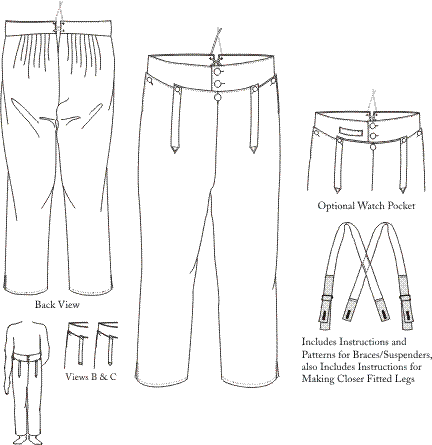
I'm making Chris's trousers, but there are several available ready-made for purchase. For my project, I'm using another Kannik's Korner pattern, High-Waisted Man's Trousers c. 1790-1810. I should probably have just bought a pair for him (hey, there's still time) but I'm worried the ready-made ones would look a little wide instead of long and lean, so I'm hoping I can achieve the desired silhouette without too much hassle.

Tuesday, October 26, 2010

Melton and Hymo and Canvas, Oh My!

As we get deeper and deeper into the year, the next Jane Austen Evening looms closer and closer...so rather than working on the coat, which should be my priority, I've been stalling and working on the other (easier) parts. I think Chris might be getting worried that he'll be coatless, cause he's been nudging me back to working on it. He'd rather have a tailcoat than trousers...to each their own! ;)

We set a shopping date to go to B. Black in downtown LA this Saturday. I'm hoping to get everything in one trip because their hours are a little limited so going back several times would be a pain. This means I need to figure out how the darned thing goes together, so I can get the right stuff - easier said than done!

I've only found a couple resources that describe Regency men's coat construction. To Cut a Regency Coat offers descriptions of the inner construction, and Men's Garment's 1830-1900 has a couple pages and a diagram. Not much to go from, but it's a start. Oh! And Lauren has progress shots of her tailcoat in this blog post.

What I've learned is that these garments were less heavily tailored than jackets today - no shoulder pads, self facing/lining at the front, and only a canvas or linen stay at the back neck (the back is unlined). The front skirts were lined with a contrast fabric.

I'm a little panicked, but lists make me feel more in control. What am I missing?

Shopping List
Wool Melton for Body & Front Facing
Contrast Fabric? for Collar
Lining (cotton?) for front skirt & maybe sleeves
Hymo for front interfacing & front shoulder
Collar Canvas for collar interfacing (I already have some, or else I wouldn't be so spendy!)
Undercollar Felt
Twill Tape for roll line
Thread
Buttons (self-covered?)

Can I just say how glad I am that I'm skipping making Halloween costumes this year?

Wednesday, October 13, 2010

The Pirate Shirt

So if I run out of time to finish Chris's outfit before the next Jane Austen Evening, the good news is that he can just wear a pirate outfit to look authentically 19th Century, right?

Not just for Halloween! ;)

Okay, not quite, but the pirate/poet shirt is based on period shirts -  and chest hair aside, this one has the correct general look. Oversized body, dropped shoulder, big blouse sleeves, deep neck slit and a ruffle down the front. But period shirts have some differences from modern shirts, especially the ones of the pirate costume variety.

Fabric
Lord Byron inspired
"poet" shirt trends for centuries
Shirts were primarily made of linen and sometimes cotton. These fabrics are easy to clean and hardwearing, so they can take a good scrub without falling apart. Bright white and high thread count is good for a gentleman - if you're portraying a lower class, you can have use an unbleached, coarser fabric. Stay away from the shiny polyester!

Construction
The fascinating thing about period shirts is that they were made entirely of different sized rectangles - every seam is a straight line. Gussets are inserted at the neck, underarm, etc to help curve around the body, and the excess fabric is gathered up into the collar and the cuff. That's why the shirts are so blousy. If you make your own shirt, decide if you want to use a modern costume pattern that has shaped pieces, or a period pattern with all straight pieces. (A modern pattern might not be "accurate", but it might look perfectly nice and will use modern sewing techniques.)

Variations
There are a few decorative options to consider. Do you want a front ruffle or plain front? Do you want sleeve ruffles (though these fell out of fashion by the early 19th C.)? Are you going to use traditional thread buttons, or find some metal or shell buttons instead? Be sure to consider the class you're representing and the formality/informality of the event, but have fun with your choices.

References
Extant* 1807 Shirt from The National Maritime Museum
Front View


Close-Up of Collar


At the blue door - a lovely blog entry about making a period shirt. Fantastic pics and info!
Kannik's Korner - Shirt Construction
Vintage Shirt Company - Repro shirts, shows a variety of options

*Extant means "existing". I just recently looked that up!

Tuesday, September 7, 2010

Inspiration and Research


My initial research on this Regency tailcoat project takes two paths - first, looking at the period in detail and finding inspiration images, and second, finding construction resources (books, sewing patterns, etc.) to help recreate the look. This list is by no means comprehensive – it’s just the resources I’ve found to be the most helpful so far. Please comment on any other men’s Regency resources you’ve found!

Inspiration & Period References
After spending some time trolling the internet, we found this image on Wikipedia. It's listed as "Portrait d'un artiste" ("Portrait of an Artist") by French painter Michel Martin Drolling, from 1819. My husband, Chris, likes this look best of anything we looked at. (I'm going to start calling him by name because saying "my husband" every time is going to become tiresome!) He specifically mentioned that he likes the double-breasted jacket, with the low front drop, and the turned back cuffs. The shape of the waist - nipped-in - also reminds me of the 1930's jacket silhouette that he's so fond of. Wikipedia suggests that the sitter in the portrait was wearing a corset – luckily, Chris is a slim guy, so no corset's necessary for him. Whew - that would be *quite* the blog entry!


Portrait of an Artist, Michel Martin Drolling, 1819
Strictly speaking, this look is probably too casual for an evening ball, but at most historical recreation events there is quite a bit of leeway for interpretation. I feel that's it's more important to feel comfortable in your clothes than to be "just-so", so if Chris wants to wear a green coat instead of blue or black, skip the hat, turn back his cuffs and leave the coat unbuttoned, I think those are all good things. To me, that's when it stops looking like a costume and starts looking like clothing.

Other sites & books I've found valuable in researching the proper Regency look are:
Wikipedia Entry on Regency Fashion
Oregon Regency Blog: Outfitting the Regency Man
Jessamyn's Regency Costume Companion
19th Century Fashion in Detail by Lucy Johnson - mostly women's clothes, but there are a few beautiful men's coats, photographed in detail. I highly recommend this book and its V&A companions.


Construction Resources

Reference Books/Websites:
Tidens Toej Regency Suit - not only do they have an actual suit to examine online, there is a free PDF of the pattern
The Cut of Men's Clothes: 1600-1900 by Norah Waugh -  contains images, descriptions, and scaled patterns - including a scaled down pattern from a 1825 tailcoat
Men's Garments 1830-1900 by R.I. Davis - Written for theatrical costumers, this book takes historical fashions and simplifies them a little for modern users. Contains scaled drafts, but the earliest pattern is an open front tailcoat from 1830, so it doesn't meet Chris's double-breasted requirement.

Commercial Patterns:
There are a few commercial patterns available for Regency tailcoats, but I’m a little hesitant to try them. The two primary companies that I’ve come across are Reconstructing History and Rocking Horse Farms – I’ve never used patterns from either company, and I haven’t found many (any?) favorable reviews of these patterns. Plus I think the illustrations and photographs are terrible – completely uninspiring. Still, I’m having a little trouble figuring out the proper construction of the tails, so I might wind up purchasing a pattern for construction reference if nothing else. If you have experience with either pattern, please comment!

Pattern Reviews:

Costume Diaries:
Wearing History Blog – Although her blog posts don’t go into detail, the Wearing History blog has been been a helpful starting place for me, as resources on making regency tailcoats are few and far between…Plus the finished coat is beautiful – probably the best Regency tailcoat I saw at last year’s Jane Austen Evening. Excellent fit, construction, the whole nine yards. (I'm trying to not let her statement that this coat "nearly killed me" intimidate me too much!)
Victorian Tailcoat Construction – this coat is a slightly later period, but I’m hoping the detail of the photographs will be helpful in figuring out the tail construction

**Whew! Finished this monster post, and now hopefully I can start sharing some of my actual work!**