I was under the weather last week and got a little behind on sewing, but my final coat mockup is nearly done and I'm pretty happy with it. I warned Chris that tomorrow night we need to take pictures, so I should have that for you soon.
 |
| Lord Grantham wearing Fall-Front Trousers, 1816 |
In the meantime, I've got some trouser resources to share. First off, here are a couple basic things I learned recently (and that I'm a little embarrassed I didn't already know).
1. Trousers are long pants. Breeches are short pants. These terms are not interchangeable, and although modern riding breeches may be long and tight, that's not what the period term means.
2. Fly-front and Fall-front trousers were both fashionable in the 18th & 19th centuries, and the trend would swing back and forth between the styles. I thought that fly-front was more "advanced", and that once it was developed, fall-fronts fell out of fashion forever. Wrong. Fly-fronts were popular in the mid-18th century, and then fall-fronts came in during the Regency period.
Here's a general breakdown: Breeches in fine fabrics were worn with stockings and buckle shoes, and were strictly upper-class. Breeches in solid colors but quality fabrics (linen, leather, cotton) could be worn by the upper- or middle-class, depending on the occasion. Trousers in quality fabrics are upper- or middle-class, and considered fashion forward and trendy. Trousers in poor fabrics were for the lower-classes, where the style originated.
 |
| Pierre Seriziat in leather breeches, 1795 |
Here are some resources to look at for visuals:
When selecting whether your Mr. Darcy will be wearing breeches or trousers, consider both his persona and personal comfort. As I've said before, Chris didn't want to wear breeches and stockings, which is fine - we're going for a late Regency look (around 1820, I guess), and by that time trousers were acceptable for a man of any age or class, unless you were going to be presented at court that day. Nothing that fancy in our future, I'm afraid!
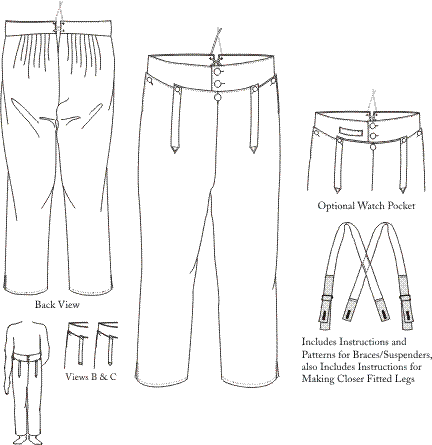
I'm making Chris's trousers, but there are several available ready-made for purchase. For my project, I'm using another Kannik's Korner pattern,
High-Waisted Man's Trousers c. 1790-1810. I should probably have just bought a pair for him (hey, there's still time) but I'm worried the ready-made ones would look a little wide instead of long and lean, so I'm hoping I can achieve the desired silhouette without too much hassle.