Thursday, November 25, 2010

Sewing on a Schedule

Several years ago, I decided to stop making clothes for specific events - at that point I was pretty much only sewing 30's & 40's clothes for swing dancing, and it didn't really matter if I wore one blouse or another - if I didn't finish it this week, I could wear it next week. I found that if I didn't try to finish by a certain date, I slowed down and the quality of what I made was exponentially better.

While my sewing's gotten much better, I've also become slower than I should be - strangely, I started enjoying the creation process so much that reaching the end of a project wasn't my primary goal. This project is forcing me to pay more attention to the calendar, but I'm worried that I'll rush and become sloppy and cut corners, especially since so much of this is new for me. (yes, I have been called a perfectionist once or twice...)

This was already weighing on me, and then we just decided to put our house up for sale next week. (We've been wanting to relocate to be closer to Chris's job for a while, and we decided to stop putting it off and try to make it happen.) One more ball to juggle!

In order to keep on schedule, I've decided to eliminate as much handsewing as possible, even if the machine stitching shows (buttonholes, etc). I'm just not fast enough at it yet, and it's been one more new skill to learn that's been slowing me down. I also might not finish his complete outfit by January 22, but I want to have at least a couple pieces for Chris, and hopefully a new dress for myself.

Any tips for dealing with these large costume projects? Lists? Elves? Valium? :)

Cute kitty picture to lighten things up! :)

Wednesday, November 24, 2010

Bling

Formal Dress Suit - German, 1805

One of the pieces I was taken with at the LACMA exhibit was this formal dress suit with detachable buttons. Instead of being stitched on, the buttons are attached to the coat and waistcoat through eyelets - this way the same set of buttons could be used for multiple suits. So clever!
Case with 2 sizes of buttons
Detail of Eyelet Holes


Here are some men's shoe buckles from 1770-1790. Not very Beau Brummell-y, but well within the accepted timeframe for the Jane Austen Evening!


Fashioning Fashion At LACMA

Men's Timeline
Women's Timeline
Last weekend a friend and I went to see the exhibit Fashioning Fashion: European Dress in Detail, 1700-1915 at the Los Angeles County Museum of Art. They acquired an extensive private collection a few years ago, and this is the first time these pieces have been on display. We took a gallery tour of the exhibit, and the docent promised that more exhibits are being planned for the collection. I hope so!


Here's a few shots of the exhibit - I was surprised at how it was designed to look so temporary, with every piece in its own "packing crate", but I enjoyed that most items weren't behind glass. The lighting was low and photography was only allowed without a flash, so most of the pictures are a little wonky. But that's typical for my blog! ;)
We were surprised
to see several garments
that didn't match
plaids or stripes!


If you can't make it to the exhibit, check out the gallery catalog - it's got wonderful detail images, and even more info on the items than the exhibit had. The quality of the photography is equal to the V&A Fashion in Detail series, although the V&A books have more photos and Fashioning Fashion has more commentary. Plus the catalog has an inside view photo of an 1825 tailcoat - the construction is slightly different from mine, because it has a waist seam, but I'm thrilled to have a reference image finally!
This waistcoat is
long-sleeved - see it poking
out under the jacket cuff?


I snagged a 1/2 price museum membership on Groupon a couple weeks ago, so I'm planning to go back a couple more times before the exhibit closes in March. Who's in for a trip? :)

Saturday, November 20, 2010

Final Tailcoat Mockup

One cuff jauntily turned back
Here she is, finally! The final tailcoat mockup. For this mockup, instead of muslin I used a mid-weight washed canvas for the body and sleeves, which is closer to my final fabric.

I'm fairly happy with how it's turning out - the body has a pretty good fit, I got the front and back tails to be the same length finally, and I'm even a little surprised with how nice the collar looks. The final coat feels within reach!

We took the pictures after Chris got home late after work, so there's no head and just a modern shirt. ;)


Tuesday, November 16, 2010

Powdered Wigs, Here We Come!

I figured out how to get Chris to wear breeches and stockings - I told him we can be Dean Collins and Jewel McGowan in Chool Song for Halloween next year. He's all for it!


Monday, November 15, 2010

Trousers & Breeches Resources

I was under the weather last week and got a little behind on sewing, but my final coat mockup is nearly done and I'm pretty happy with it. I warned Chris that tomorrow night we need to take pictures, so I should have that for you soon.

Lord Grantham wearing Fall-Front Trousers, 1816

In the meantime, I've got some trouser resources to share. First off, here are a couple basic things I learned recently (and that I'm a little embarrassed I didn't already know).

1. Trousers are long pants. Breeches are short pants. These terms are not interchangeable, and although modern riding breeches may be long and tight, that's not what the period term means.

2. Fly-front and Fall-front trousers were both fashionable in the 18th & 19th centuries, and the trend would swing back and forth between the styles. I thought that fly-front was more "advanced", and that once it was developed, fall-fronts fell out of fashion forever. Wrong. Fly-fronts were popular in the mid-18th century, and then fall-fronts came in during the Regency period.

Fall-Front Breeches
available from
Jas. Townsend
Fly-Front Breeches
available from
Jas. Townsend

Here's a general breakdown: Breeches in fine fabrics were worn with stockings and buckle shoes, and were strictly upper-class. Breeches in solid colors but quality fabrics (linen, leather, cotton) could be worn by the upper- or middle-class, depending on the occasion. Trousers in quality fabrics are upper- or middle-class, and considered fashion forward and trendy. Trousers in poor fabrics were for the lower-classes, where the style originated. 
Pierre Seriziat in leather breeches, 1795

Here are some resources to look at for visuals:

Circa 1820 Trousers - scroll to the bottom of the page. Note the narrow fall front
Circa 1850 Trousers at Vintage Textile - great detail images, note the machine stitching and wide fall that indicates the later period

Fashioning Fashion - Zoom in on Foxyhunter's foxy breeches!
A post about Buckskin Breeches - I really like the comparison to comfortable old jeans
Jessamyn's page on menswear - great variety of images of Regency breeches & trousers


When selecting whether your Mr. Darcy will be wearing breeches or trousers, consider both his persona and personal comfort. As I've said before, Chris didn't want to wear breeches and stockings, which is fine - we're going for a late Regency look (around 1820, I guess), and by that time trousers were acceptable for a man of any age or class, unless you were going to be presented at court that day. Nothing that fancy in our future, I'm afraid!

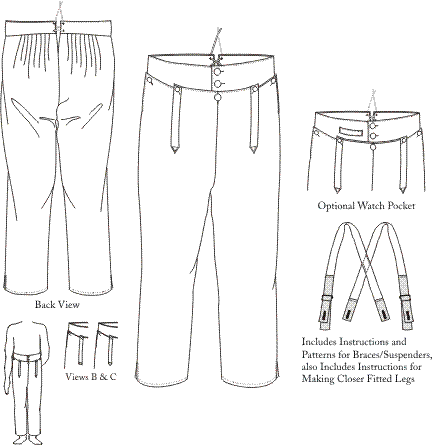
I'm making Chris's trousers, but there are several available ready-made for purchase. For my project, I'm using another Kannik's Korner pattern, High-Waisted Man's Trousers c. 1790-1810. I should probably have just bought a pair for him (hey, there's still time) but I'm worried the ready-made ones would look a little wide instead of long and lean, so I'm hoping I can achieve the desired silhouette without too much hassle.

Monday, November 8, 2010

Tailcoat Sleeve Cuff

As I posted last time, I find the tailcoat sleeve cuff intimidating - and still do, even after working on it. I'm just not sure how it's supposed to work, with an overlap but no slit/placket above the cuff like on a shirtsleeve, so it's the construction aspect that's tripping me up. I'm just winging the whole cuff thing because the only references I can find for this style of cuff are portraits (so not much nitty-gritty detail), but it seems like there was enough variation in cuff construction and style that I should have some leeway.

Instead of using the cuff pattern from Tidens Toej, with its wavy lines that also probably aren't the right length (since I drafted my own undersleeve pattern), I decided to draft my own cuff pattern. I just did straight lines, with a little flare at the end - it's going to be a trial and error pattern piece.

First Cuff Draft and Mockup


The first cuff with the straight edges is a little too tight at the front (top edge of the mockup), and I want it to flare more over the hand. I was reading this article by Lynn McMasters on the shape of different top hats, and realized that the flare of the top hats illustrated are similar to the shape I want for my cuff. So I reworked the cuff to curve, more like top hat pattern "D".


2nd Cuff, based on top hat shape


I like this version more - the cuff definitely has more attitude now! And after playing with cuff shapes, I realized that the 1825 tailcoat in Norah Waugh's Cut of Men's Clothes has a curved cuff too. I love discovering the nuances of period clothing - different coats in the same period would have had different cuff shapes, and it's fun to have options.